Are neurodivergents better at jigsaw puzzles?
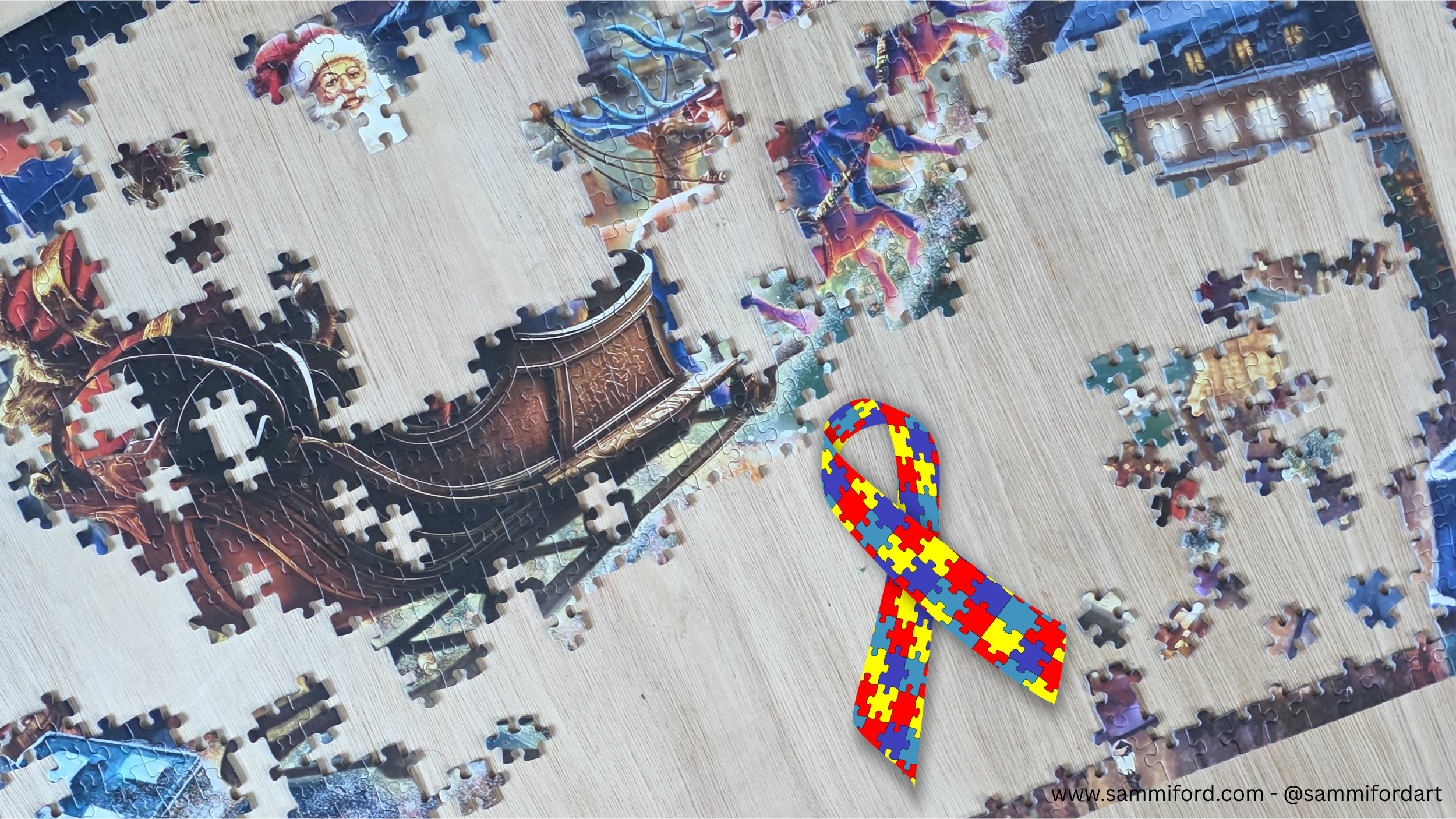
jigsaw puzzle and the autism symbol - @sammifordart
Can the strategy of starting with the edge pieces of a jigsaw be likened to following societal norms?
It is customary for our family at Christmas to tackle a new jigsaw and 2025 was no different. Placing a few pieces each day over the festive period allowed us to unwind and bond at the only time of the year when we get to be together.
As usual, we started the puzzle with the edge pieces, a popular strategy because it:
Creates a clear boundary and visual reference points.
Edge pieces form the frame of the canvas. When the dimensions and shape of the puzzle are clear, it can be easier to gauge the scale of objects within the picture. Once assembled, the interior pieces should be easier to place.
Is easier and quicker to construct to simplify sorting.
In a typical puzzle, only a few of the pieces are edges and they all have at least one straight side. They are easier to separate from the rest of the picture pieces which can then be sorted into colours or categories to reduce time later on.
Boosts momentum and motivation
The rest of the puzzle seems more manageable with a visual cue to start with. Progress is encouraging and can maintain momentum when working on the more challenging interior areas.
However, maybe the traditional approach is not always the best strategy.
Edge pieces are often of similar colour and size and they all have at least one straight and uniform edge. As the interior of the jigsaw began to take shape, it became apparent that the frame within which we were working had been incorrectly assembled. The image was expanding beyond its boundaries in certain directions and in others there was too much space.
We had to disassemble the confining structure of the border to give space for the image to expand. In a moment of inspiration, like ‘the pieces falling into place’, I saw an analogy between the jigsaw and society.
Social conformity bias is the tendency to align one’s own beliefs or behaviours with those of societal expectations. This was demonstrated in the famous Asch conformity experiment of the 1950s which asked participants to match a line with another of the same length. Most participants gave obviously incorrect answers, copying actors’ responses to fit in with the group.
Social influence can skew perception, just like with the outline of the Christmas jigsaw.
The majority of people tend to conform to perceived norms and traditions even without reason. Think turkey and cranberry sauce or lamb and mint sauce. Why don’t we mix and match condiments? Personally, I love mint sauce on anything!
It is generally accepted that those with neurodivergent minds, such as having autism, ADHD or dyslexia, tend to be less pressurised to follow the crowd, the reasons for which being open to interpretation. They are often able to solve puzzles easier and more quickly than the typical population, partly due to logical thinking, pattern recognition and attention to detail. Many companies, including GCHQ and Microsoft, actively recruit neurodivergent individuals due to these strengths.
As a neurodivergent person myself, with AuDHD (autistic and ADHD), my mind does work differently to that of most typical people when solving a puzzle, even a jigsaw.
Just as quickly as I can spot a spelling mistake in a page of text (hyperlexia), I can pick up a jigsaw piece and identify immediately where it belongs in the image. Self-analysing my method, I realised that I was picking up on unusual characteristics in each puzzle piece such as whether the detail was in focus as part of the foreground or background. This may be enhanced by my experience as a photographer and artist, or perhaps my neurodivergence allows me to see and identify detail in an aytpical way.
Innovation must start with divergence from the norms by those who are willing to challenge prevailing assumptions.
Paradoxically, the autistic movement has recently rejected the puzzle piece as its symbol, considering it to negatively represent the idea that something is missing in the minds of those who are neurodivergent.